
Top

Birzebbuga

Travelling the network

BIRZEBBUGA

BACKGROUND

The seaside town of Birżebbuġa is situated at the southeast of the island of Malta and lies between Kalafrana to the south and the fishing village of Marsaxlokk to the northeast, and although Birżebbuġa is on the coast, it is the meeting point of four beautiful valleys, which are Wied Dalam, Wied Zembaq, Wied Qoton and Wied Buni.

Many stories revolve around the name of Birżebbuġa. For example, legend has it that olives were stored in wells filled with sea water; another story is that olive trees were planted in and around what was then a small village; another is that when the word ‘Birżebbuġa’ is divided into ‘Bir’ and ‘żebbuġa’, ‘Bir’ means a well, while ‘żebbuġa’ means an olive, thus when the two are joined together the word ‘Biżebbuġa’ will emerge, and finally there was the question of whether the name should be pronounced Bur Żebbuġa or Birżebbuġa because Bur Żebbuġa means land of olives. Up until the end of 1800’s wells, which would have been used for olives, could be seen at the bottom of the sea where it is shallow. Today wells are still in existence and can be seen on the rocks at St. George’s Bay.
WHAT TO SEE

Birżebbuġa, located in southern Malta, is best known for Pretty Bay, a man‑made sandy beach that attracts locals for swimming and sunbathing. The bay features a promenade, cafés, and a playground, though its proximity to the Malta Freeport means the industrial backdrop is not to everyone’s taste. Nearby, St. George’s Bay has become a popular spot for water sports.

Close to the village lies Għar Dalam, meaning “dark cave,” an important archaeological site where the earliest evidence of human presence in Malta was uncovered, dating back to the Neolithic period around 7,400 years ago. The site includes both the cave—144 metres deep, with the first 50 metres accessible to visitors—and a museum displaying animal fossils and human artefacts. Its deepest layers, over 500,000 years old, contain remains of dwarf elephants, hippopotami, micro‑mammals, and birds. Above these is the “deer” layer from about 18,000 years ago, while the uppermost deposits, less than 10,000 years old, reveal traces of Malta’s first inhabitants, supporting the theory of a former land bridge to continental Europe.

Nearby, the Bronze Age site of Borġ‑in‑Nadur (c.2000 BC) features a four‑apse temple and a fortified settlement, marked by a massive inland defensive wall. Its positioning suggests the community feared attacks from land more than from the sea, offering insight into the defensive strategies of Malta’s prehistoric people.

Another attraction is Għar Ħasan Cave, perched dramatically on a cliff near the Freeport, about 2.5 km from Birżebbuġa on the road to Żurrieq. A 25‑minute walk from the village leads to this cave, which legend associates with a 12th‑century Saracen pirate named Ħasan. According to tradition, he abducted a Maltese girl and hid her there, but when discovered by locals, he killed her and leapt into the sea rather than be captured.

Birżebbuġa also preserves historic structures from the Knights of St. John, including the Ferretti Coastal Battery and the village entrenchments, adding further depth to its rich cultural heritage.

HOLY WEEK AND EASTER

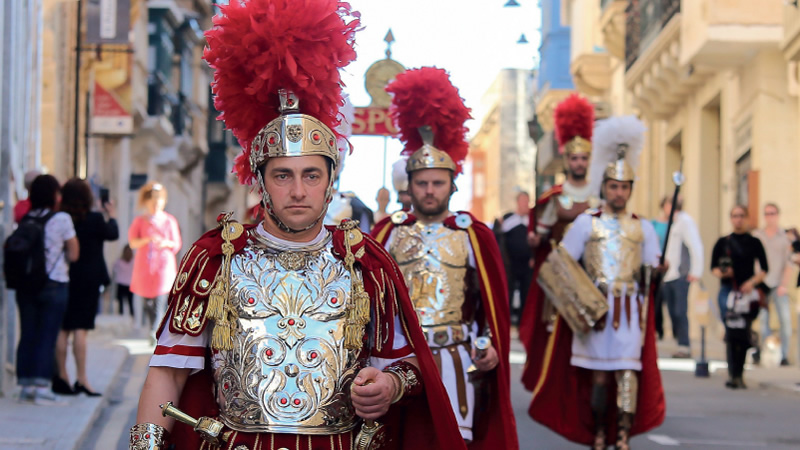
During Holy Week, Birżebbuġa observes traditional Maltese religious practices with a mix of solemnity and joy. The events begin on the Friday before Palm Sunday with the procession of Our Lady of Sorrows, a deeply moving tradition that sets the tone for the week. On Palm Sunday, olive branches are blessed and carried in procession, often with children dressed in Jewish costumes. Maundy Thursday brings Mass at the parish church, including the washing of the feet, followed by visits to the Altar of Repose. On Good Friday, a ceremony at 3:00 PM commemorates the Passion and Death of Christ.

The celebrations culminate on Easter Sunday with a festive Mass and the traditional “run” with the statue of the Risen Christ, accompanied by a family Mass and the blessing of figolli, Malta’s beloved Easter sweets. Throughout the week, homes are decorated, special services are held, and local community groups organize additional activities, making Holy Week in Birżebbuġa both a spiritual and cultural highlight.

It is common for homes in Malta to be decorated with miniature religious statues and draperies during Holy Week.

LUGARES EN LA RED

Serbia

1 destinations

Portugal

5 destinations

Spain

13 destinations

Italy

3 destinations

Malta

13 destinations

Slovenia

1 destinations

Croatia

2 destinations

0